Article: Stop Asking Who Sells Solar Generators. Ask This Instead.
Stop Asking Who Sells Solar Generators. Ask This Instead.
Before you spend a dime, forget the brand. Forget the logo on the box. Here's how I'd actually walk a luxury homeowner or a serious prepper through choosing one.
Everybody starts the same way. They Google "who sells solar generators," land on a retailer page, and start scrolling logos like it's a car lot. I get the instinct — it feels like due diligence. It isn't. And it's cost real people real money, along with the peace of mind they were trying to buy in the first place.
Here's the truth of it: the solar generator market is flooded right now. Dozens of companies, hundreds of SKUs, and enough marketing language to bury a load calculation six feet deep. The question was never who's selling them. It's what separates a system that carries your home through a five-day outage from one that dies protecting your refrigerator on day two. Stick with me through this, and the brand question answers itself — because by then, you won't need to ask it.
The Consensus Is Wrong: Brand Shopping Misses the Point
Most people shopping for a solar generator do exactly what they'd do buying a blender. Google a name. Check the stars. Don't overpay. Feels methodical.
A solar generator is not a blender.
The market crossed $723 million in 2025 and it's climbing fast, which means more SKUs, more noise, and more ways to buy the wrong unit with total confidence. The top five players hold 40% of that market between them — and every single one of them sells a product that reads beautifully on a spec sheet and folds badly the moment it meets the wrong use case.
The Watts-and-Watt-Hours Test
Let's make this concrete. Say you want to keep a full-size refrigerator running through a grid outage — a common ask from my luxury clients. That fridge draws maybe 150 to 200 watts running steady, but the compressor surges past 1,000 watts just to start up. Add a window AC unit or a mini-split into that math and you've already blown past what most of the "popular" units on Amazon can actually deliver — five-star reviews notwithstanding.
That's the real question, and it's the only one that matters: does this unit's continuous output and total watt-hour capacity match your load? Brand trust doesn't answer that. The spec sheet does. Everything else is noise dressed up as research.
Buy on brand alone and you land in one of two ditches — an underpowered unit that quits in hour three, or an overbuilt one gathering dust in the garage next to the treadmill nobody uses. Neither is a bargain. The framework has to change before anything else does.
The Four Specs That Actually Determine Whether It Works for You
Most buyers never get past the headline wattage number on the box. Maybe the price. Maybe the star rating. That's exactly how you end up with a unit that dies mid-outage or takes nine hours to recharge under an overcast sky. Four specs — and only four — actually decide whether this thing performs when you need it to.
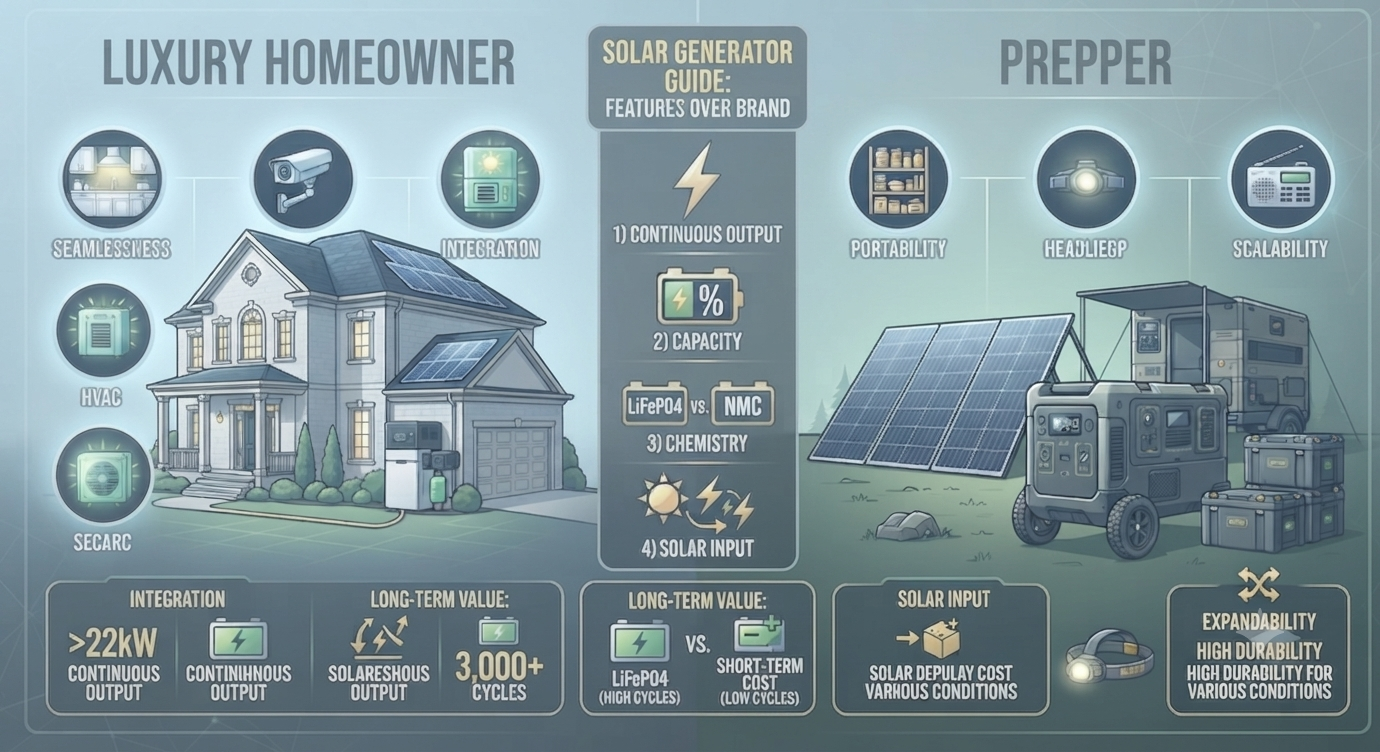
Continuous Output Wattage. This number tells you what the unit can actually run, not what it can briefly survive. Peak wattage is the number manufacturers love to slap on the box. Continuous wattage is what keeps your refrigerator, your medical equipment, or your sump pump alive at hour six. Exceed it, and the unit throttles down or shuts off entirely. That's your single point of failure, sitting right there in plain sight.
Battery Capacity (Wh). Watt-hours tell you how long the lights stay on. A 1,000 Wh battery running a 100-watt load buys you roughly 10 hours, and less once you account for real-world inefficiency. Most people underestimate their load and overestimate how cooperative the sun is going to be. Size this one generously — it's cheap insurance against a math error.
Battery Chemistry — LiFePO4 vs. NMC. This is the quiet spec that separates a decade-long investment from a three-year one. LiFePO4 batteries run 3,000 to 7,000 charge-discharge cycles. NMC batteries typically top out between 1,000 and 2,000. That gap compounds fast — for daily cycling, you're looking at 8 to 12 years of hard use out of LiFePO4 versus 3 to 6 before noticeable fade with NMC. For a stationary backup system — not something you're strapping to a hiking pack — the weight penalty of LiFePO4 is irrelevant. The longevity isn't.
Solar Input Rate. This tells you how fast the unit actually refills from panels. A big battery that recharges slowly is a real problem the moment day two of overcast weather shows up uninvited. Check the maximum solar input in watts against your panel capacity. Mismatch the two, and you're topping off at 30% by nightfall, betting the rest of the week on tomorrow's forecast.
Here's the part nobody tells you: weakness in any one of these four doesn't just inconvenience you a little. It renders the other three irrelevant. All that glitters is not gold, and a beautiful battery bank feeding off a garden-hose solar input is exactly that kind of glitter.
Luxury Home vs. Prepper: Same Product, Completely Different Requirements
Here's the part that surprises people: the unit that's exactly right for one of you is probably wrong for the other. Not slightly off — wrong in ways that cost real money and real frustration down the road.
What the luxury homeowner actually needs. Conventional wisdom says bigger is always better, and for a large home there's some truth in that. But raw capacity isn't the real fight — friction is. For my Zero-Flicker clients, the limitation was never capability. It's whether the system disappears into the background of a life that was built to run without interruption. For larger estates, you're often in the 22,000 to 32,000-watt range once you account for electric ovens, water heaters, and multiple HVAC zones running simultaneously. A system that kicks in silently and never announces itself — that's the product. A clunky manual transfer switch, an extension cord snaking across the kitchen floor, a generator that needs babysitting? Hard stop. That's a dealbreaker, full stop on the sales conversation.
What the prepper actually needs. Nearly the inverse. Portability matters. Scalability matters more. The homestead builder I respect most isn't buying maximum capacity today — he's buying an ecosystem that grows with him, from a weekend outage to a genuine grid-down scenario. LiFePO4's 3,000-plus cycle life is non-negotiable here too, but for a different reason: this buyer expects to actually run the thing hard, not admire it in a closet. Expandability isn't a nice-to-have for him. It's the architecture. Scaling from 2,048Wh up toward 6,144Wh as the budget and the homestead grow means he's never locked into a ceiling he can't afford yet.
The prepper isn't optimizing for invisible. He's optimizing for durable, deployable, and ready the moment it's needed — which, if you've read my work on off-grid triage, is the whole ballgame.
So what does that mean for you? The same unit can score a perfect ten for one buyer and a miserable four for the other — not because the product is flawed, but because nobody bothered to ask which buyer was standing in front of it. Before you weigh a single spec, get honest about which one you are. That answer drives every decision downstream of it.
The One Objection Worth Taking Seriously: "But Cost Has to Matter"
It does. I won't insult you by pretending price is irrelevant — that's a lazy argument, and you didn't come here for lazy arguments.
Here's the reframe, though: the sticker price is the wrong number to anchor on. The number that actually matters is cost per cycle — what you're paying every single time that unit does its job. Run that math, and "cheaper" flips on you fast.
LiFePO4 batteries typically deliver 4,000 to 8,000 cycles. Plenty of competing lithium-ion chemistries top out somewhere between 500 and 1,500. That's not a marginal gap — that's the difference between a tool and something disposable. Amortized across a battery's lifetime, LiFePO4 tends to land around $0.38 per kWh delivered, against roughly $2.55 per kWh for AGM lead-acid once you price in the replacements you'll inevitably need. The "affordable" unit was never affordable. It was just cheaper at checkout.
Now, the strongest, fairest version of the cost objection: some people genuinely cannot spend more today, no matter what the ten-year math says. That's real. Cash flow and total cost of ownership are two different conversations, and I'm not going to pretend otherwise from behind a comfortable desk.
But if you can absorb the higher upfront number — and most of my luxury clients and most serious preppers can — the math isn't close. LiFePO4 costs more on day one. Divide that cost over a ten-plus-year lifespan, and the cost per cycle usually comes in far lower than the "bargain" alternative. You're not buying a generator. You're buying a decade of reliable power. The real question was never what it costs today — it's what it costs you the day it fails you.
Buy for the five-year total. Not the five-minute checkout.
How to Actually Shop for This Thing Without Losing a Weekend to It
Most people start on a product page. That's the wrong end of the rope entirely.
Here's the framework I'd actually walk a client through — and it takes an hour, not a weekend.
Step one: calculate your load before you look at a single product. List every device you need running during an outage. Wattage, hours per day, multiplied out. Add 20% as a buffer, because real life always runs hotter than the spreadsheet. That number — your minimum watt-hour requirement — is your filter. It eliminates seventy percent of the market before you've read one spec sheet.
Step two: match battery chemistry to your actual use case. Luxury homeowner wanting a system that quietly cycles for years in the background? LiFePO4, no debate. Prepper who might run it hard for a week and then store it for six months? Chemistry and depth of discharge matter even more for you, not less. Don't let a tempting price talk you into the wrong battery — that's how good money follows bad.
Step three: filter by solar input speed. How fast does this unit actually recharge from panels? That max solar input number tells you whether you're back to full by noon or still waiting at sundown, hoping the weather cooperates. For extended outages, recharge speed matters nearly as much as capacity itself.
Step four: only now do you compare vendors. Warranty terms. Support reputation. Expansion options down the road. Not logos. Never logos.
Skip step one, and the whole framework collapses. You can burn an entire weekend clicking through product pages and still walk away with no real idea what you need — because you skipped the math that would've told you.
So before you open a single tab: what's your minimum watt-hour number? That question is worth more than every review you'll read this week combined.