The Front End Cost of "Clean Tech"
How green is this "green" technology, truly? The short version: solar panels and EVs are genuinely cleaner over their operational lifespan than the fossil-fuel alternatives they replace — but the front end of that story is ugly, and the industry's marketing machine works very hard to make sure you never linger there too long.
Here's what I mean.
The Mining Problem Is Real, and It Doesn't Get Talked About Honestly
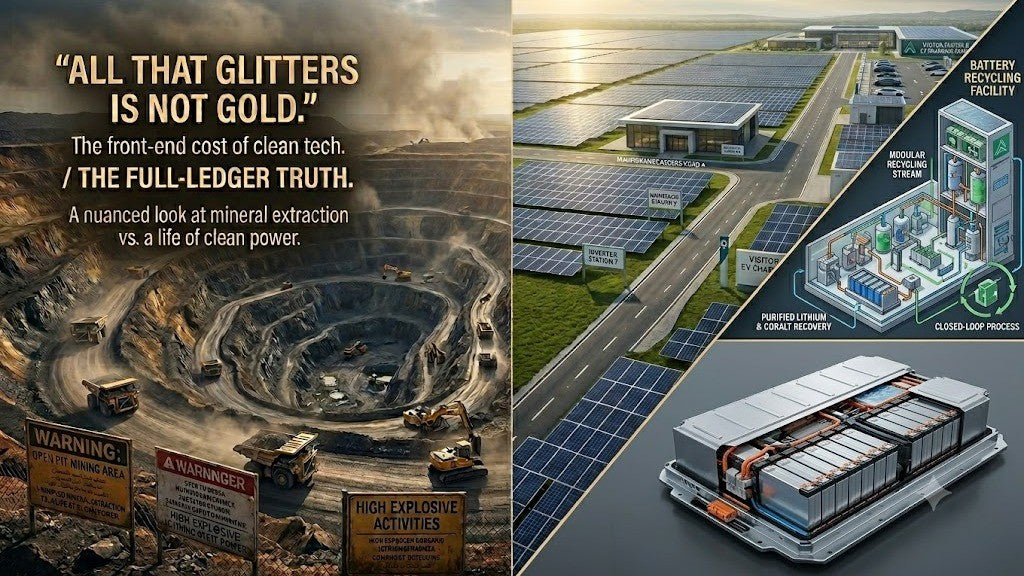
The metals that make this technology work — lithium, cobalt, nickel, manganese, copper, rare earth elements like neodymium and dysprosium — don't come out of the ground clean. They come out of the ground through some of the most disruptive industrial processes on the planet. All that glitters is not gold, and brother, some of this stuff glitters something fierce on a product spec sheet.
Lithium extraction is either an energy-intensive hard-rock mining operation (think open-pit blasting in Australia or China) or a brine-pumping process in the lithium triangle of South America — Chile, Argentina, Bolivia — where vast volumes of water are drawn from ancient aquifer systems in one of the driest places on earth. Atacama Desert communities have been fighting for years over what lithium brine extraction is doing to local water tables and the ecosystems — flamingo habitats, indigenous agricultural traditions — that depend on them. The science is genuinely contested, but "contested" is not the same as "fine." And the scale of extraction is only going up.
Cobalt is arguably the most ethically fraught piece of the supply chain. The Democratic Republic of Congo produces roughly 70% of the world's cobalt, and a significant portion comes from artisanal small-scale mining operations — a polite industry term for informal mines where safety standards are, charitably, inconsistent, and where child labor has been documented by organizations including Amnesty International. The big manufacturers have made commitments, and progress has been made. But the demand curve for cobalt is outrunning the reform curve, and anyone who tells you the cobalt in your battery pack is definitely ethically sourced is selling you something.
Copper — which is everywhere in solar systems and EVs — requires massive open-pit mining, often in ecologically sensitive regions of Chile, Peru, and the American Southwest. Sulfide ore processing produces acid mine drainage: acidic, metal-laden water that can contaminate surface and groundwater for generations if containment fails. And containment fails. It's not hypothetical.
Rare earth processing, largely concentrated in China, has a documented history of producing radioactive tailings and significant soil and water contamination at production sites. The Chinese government has been working to remediate some of the worst legacy sites, but the production footprint is enormous, and the environmental cost of building a permanent magnet motor appears nowhere on the EV sticker price. That's a line item they really don't love putting in the brochure.
Silicon — the primary material in solar photovoltaic cells — sounds benign, and in its pure form it is. But manufacturing high-purity silicon wafers is an energy-intensive process that has historically relied heavily on coal-fired power in China, where the majority of global solar panel production occurs. So the panel on your roof collecting clean energy may have been manufactured in a factory powered by some of the dirtiest electricity on the planet. That embedded carbon is real and has to be counted — like running a diesel generator to charge your home EV.
The Lifecycle Equation — Honest This Time
Here's where I won't let the complexity become a reason to dismiss the technology entirely. The lifecycle data, done rigorously, does support solar and EVs as net positives on carbon — but with important caveats attached.
The "energy payback period" for solar panels is the time it takes a panel to generate enough clean electricity to offset the energy consumed in its own production. Depending on panel type, location, and grid carbon intensity, that figure runs roughly one to four years for most modern silicon panels. Given a 25–30 year operational lifespan, the math pencils out in solar's favor — you're generating six to twenty-five times the energy required to produce the panel. That's a real number, and it's genuinely encouraging, even for a skeptic like me.
For EVs, the lifecycle carbon picture is more nuanced and more grid-dependent. A study from the Universities of Exeter, Cambridge, and Nijmegen found that EVs produce lower lifetime emissions than gasoline vehicles in 95% of the world's regions — but the margin varies enormously based on what electricity powers the charging. In Norway, where the grid is nearly 100% hydroelectric, an EV is about as clean as a vehicle gets. In Poland, where coal still dominates, the carbon benefit shrinks substantially. In the U.S., with a mixed grid that's getting progressively cleaner, the EV advantage is real and growing. And as the grid cleans up, every EV on it gets cleaner automatically, retroactively, without anyone touching the car.
The mining-side carbon footprint does mean an EV starts life with a larger embedded carbon debt than a comparable gasoline vehicle — typically 50–70% more carbon to manufacture, driven primarily by the battery pack. The crossover point, where the EV has paid back that debt through cleaner operation, falls somewhere between 15,000 and 50,000 miles of driving depending on grid mix and vehicle size. For a vehicle driven 12,000–15,000 miles per year, that's one to four years.
So: yes, cleaner over a lifetime. No, not clean from day one. The industry advertises the former and quietly omits the latter — selling you the ten percent above the waterline and hoping you never ask about the ninety percent underneath.
The Battery Disposal Question Nobody Loves to Answer
We are about to have a very large battery disposal problem, and the infrastructure to handle it responsibly is not ready. This is the part of the clean energy conversation where the room gets real quiet, real fast.
The first wave of mass-market EV batteries — from the Nissan Leaf generation, early Tesla Model S adopters — is reaching end-of-first-life now. Lithium-ion packs don't die cleanly; they degrade gradually, losing capacity over charge cycles. When a pack is no longer fit for vehicle use, it often retains 70–80% of its original capacity — genuinely useful for stationary storage applications, and a growing number of companies are building exactly that repurposing pathway. Good stewardship in practice.
But eventually the battery reaches true end-of-life, and then you have a large, heavy object containing lithium, cobalt, nickel, manganese, and assorted organic solvents that is genuinely difficult to recycle. Pyrometallurgical recycling recovers cobalt and nickel reasonably well but loses lithium and produces slag. Hydrometallurgical processes recover more material but are energy- and chemical-intensive. Direct recycling, which would preserve cathode material in usable form, remains largely at pilot scale.
The EU has passed battery regulations requiring minimum recycled content in new batteries and establishing collection and recycling targets. The U.S. is moving more slowly — bless our hearts. The recycling infrastructure is a work in progress chasing a waste stream that is growing faster than the solutions. That's not a reason to stop deploying EVs. It is a reason to push hard on regulatory and industrial investment before we have a genuine crisis on our hands.
Solar panels carry a similar end-of-life challenge. Silicon, glass, aluminum — most of the panel by weight — can be recycled. But the value of recovered material has historically been too low to make dedicated solar panel recycling economically self-sustaining without mandate. The U.S. has no federal solar panel recycling requirement. The EU does, under the WEEE directive. Washington State has passed legislation. Most of the country has not. Panels going to landfill is not hypothetical — it's happening now, in volume. Not exactly the green legacy anyone had in mind.
What I Actually Tell Folks Who Ask
The choice is not between "clean energy technology" and "less clean fossil fuels." Fossil fuel extraction carries its own massive mining, drilling, pipeline, refining, and combustion footprint — and unlike mining for battery metals, fossil fuel combustion is a continuous process. You burn it, it's gone, and the CO₂ stays in the atmosphere. The mining impact of renewable energy is largely a front-loaded, one-time cost per unit of energy produced. That's a structurally different problem, even if it's not a comfortable one.
But "better than the alternative" is not the same as "clean." And the green energy industry does itself long-term harm by overselling a purity it doesn't have. When a homeowner invests $40,000 in a solar-plus-storage system partly out of genuine environmental conviction, and later learns about cobalt mining conditions or panel disposal gaps, they feel misled. And they were — by omission if nothing else. That's not stewardship. That's a used car salesman with a recycling sticker on his bumper.
The honest case for residential solar and battery storage is this: over a reasonable lifespan, in most locations, it substantially reduces your operational carbon footprint and your dependence on grid electricity that still carries its own generation emissions. The manufacturing footprint is real but time-bounded. The technology is improving — LiFePO4 chemistry eliminates cobalt entirely, and silicon efficiency gains mean fewer panels per kilowatt of capacity. Recycling infrastructure is underdeveloped but actively being built.
It's a transition technology doing transition-technology work. It's not the endpoint. And the companies marketing it as inherently virtuous, without the full picture, are doing what hype merchants always do — handing you half the ledger and hoping you don't ask for the other half.
#EnergyStorage #MiniGrid #MicroGrid #CleanEnergy #Sustainability #GreenEnergy #BatteryStorage #HomeEnergy
Sources & References
1. Knobloch, F. et al. — "Net Emission Reductions from Electric Cars and Heat Pumps in 59 World Regions Over Time" Nature Sustainability, Universities of Exeter, Cambridge & Radboud (Nijmegen), 2020 The peer-reviewed backbone of the EV lifecycle emissions claim — the "95% of the world" finding comes directly from this study. 🔗 https://pmc.ncbi.nlm.nih.gov/articles/PMC7308170/
2. Amnesty International — "This Is What We Die For: Human Rights Abuses in the DRC Power the Global Trade in Cobalt" Amnesty International & Afrewatch, 2016 The primary sourced investigation documenting child labor in artisanal cobalt mining in the Democratic Republic of Congo — directly cited in the cobalt section. 🔗 https://www.amnesty.org/en/documents/afr62/3183/2016/en/
3. National Renewable Energy Laboratory (NREL) — "Energy and Carbon Payback Times for Modern U.S. Utility Photovoltaic Systems" U.S. Department of Energy / NREL, 2024 The authoritative U.S. government source for solar panel energy payback period data — underpins the 1–4 year payback claim and the 25–30 year lifespan framework. 🔗 https://docs.nrel.gov/docs/fy24osti/88653.pdf
4. Columbia University Climate Law Blog — "Chile's Lithium Boom: A Green Revolution or Environmental Ruin?" Sabin Center for Climate Change Law, 2025 Well-sourced analysis of lithium brine extraction's documented impact on Atacama water tables, flamingo habitats, and indigenous communities — directly supports the lithium mining section. 🔗 https://blogs.law.columbia.edu/climatechange/2025/05/06/chiles-lithium-boom-a-green-revolution-or-environmental-ruin/
5. U.S. Environmental Protection Agency (EPA) — "Improving Recycling and Management of Renewable Energy Wastes: Universal Waste Regulations for Solar Panels and Lithium Batteries" EPA.gov — Office of Land and Emergency Management The EPA's own position on end-of-life solar panel and lithium battery waste — confirms the absence of federal solar recycling mandates and documents active rulemaking. Directly supports the disposal section. 🔗 https://www.epa.gov/hw/improving-recycling-and-management-renewable-energy-wastes-universal-waste-regulations-solar
6. U.S. Department of Energy — "End-of-Life Management for Solar Photovoltaics" Energy.gov — Solar Energy Technologies Office DOE's summary of the solar panel end-of-life challenge, NREL recycling research, and the gap between deployment growth and recycling infrastructure readiness. 🔗 https://www.energy.gov/cmei/systems/end-life-management-solar-photovoltaics
7. European Commission — EU Batteries Regulation & WEEE Directive EUR-Lex — European Union Legislative Database The legal text behind the EU's battery recycled-content requirements and the WEEE Directive's mandatory solar panel collection framework — cited in the contrast between EU regulatory posture and U.S. inaction. 🔗 https://eur-lex.europa.eu/legal-content/EN/TXT/HTML/?uri=CELEX%3A52020PC0798y